Key facts
- FAO said KIAMIS was created to address fragmented farmer data and had registered more than 6.5 million farmers by mid-2025.
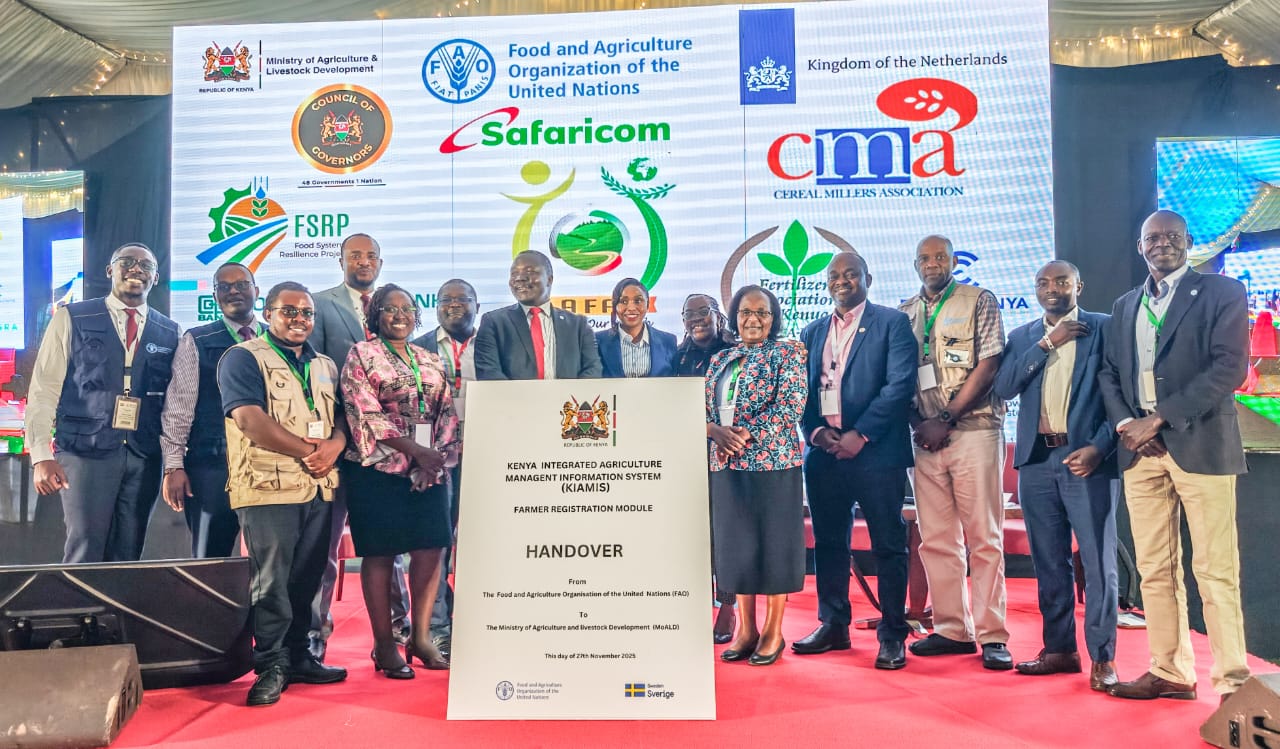
- The Star reported in November 2025 that KIAMIS was handed over to Kenya’s Ministry of Agriculture and housed under KADIC.
- Business Daily reported that Kenya is preparing a framework to open agricultural data to private developers and improve interoperability.
- FAO’s Lake Region TUNZA project spans 14 counties and focuses on climate-resilient agricultural value chains.
- The Lake Region initiative reflects a wider Kenyan shift toward integrated, data-driven agriculture systems.
A regional data push built on existing digital agriculture work
Kenya’s Lake Region Economic Bloc is moving further into digital agriculture, with a new flagship effort aimed at consolidating agricultural data across the bloc’s counties. The initiative comes at a time when the country is already expanding the use of farmer registration, digital service delivery and traceability tools in the agriculture sector. What is new in this latest push is not the idea of digitisation itself, but the ambition to bring more of the region’s agricultural information into one coordinated system that can support planning and service delivery at scale.
The Lake Region bloc covers 14 counties, including Kisumu, Homa Bay, Siaya, Migori, Kisii, Nyamira, Bungoma, Busia, Vihiga, Kakamega, Trans Nzoia, Nandi, Kericho and Bomet. Agriculture is central to livelihoods across this belt, and county governments in the region have long argued that fragmented data makes it harder to target inputs, extension, market support and climate interventions. FAO’s work in Kenya shows that the organisation has been involved in building digital agriculture systems for several years, including the Kenya Integrated Agriculture Management Information System, or KIAMIS, which was developed with the Ministry of Agriculture and supported by Sweden. ([fao.org](https://www.fao.org/kenya/news/newsdetails/FAO-Participates-in-the-11th-Summit-of-LREB/en?utm_source=openai))
Against that background, the new Lake Region initiative should be understood less as a standalone invention and more as part of a wider architecture that is already taking shape. FAO said KIAMIS was created in response to fragmented and incomplete farmer data, and that by mid-2025 more than 6.5 million farmers had been registered in the system. Later reporting from The Star said the figure had risen to more than 7.1 million by November 2025, underscoring the scale of Kenya’s digitisation drive in agriculture. ([fao.org](https://www.fao.org/agroinformatics/news/news-detail/official-handover-of-kiamis-to-the-government-of-kenya--a-new-era-for-digital-agriculture/en))
Why governments want a common agricultural data layer
The practical case for consolidating agricultural data is straightforward. County and national officials need timely information on who is farming, what is being grown, where production is occurring, what inputs are being distributed and how crops or livestock are performing under changing weather conditions. When these datasets sit in separate systems, or remain on paper or in disconnected databases, it becomes difficult to compare them, verify them or use them quickly for policy decisions. Business Daily recently reported that Kenya is preparing a broader framework to open agricultural data to private developers, with the goal of improving interoperability, reducing duplication and enabling more responsible information-sharing across institutions. That report noted that public agricultural data can include production statistics, soil information, weather patterns, satellite imagery, pest surveillance, input distribution data and commodity prices. ([businessdailyafrica.com](https://www.businessdailyafrica.com/bd/corporate/technology/kenya-seeks-to-open-agricultural-data-to-tech-developers-5391902))
This matters in the Lake Region because the bloc’s agricultural economy is exposed to several pressures at once. Climate volatility is affecting yields, counties are under pressure to strengthen food security, and farmers often need faster access to extension advice and input support than paper-based systems can deliver. FAO has repeatedly described its Kenya work in the Lake Region as focused on climate-resilient, low-carbon and data-driven agriculture, including the TUNZA project, which spans the bloc’s 14 counties and is designed to strengthen value chains, climate resilience and rural livelihoods. ([fao.org](https://www.fao.org/kenya/news/newsdetails/tunza-draws-a-roadmap-to-safeguard-people-and-planet-during-project-implementation/en?utm_source=openai))
The consolidation effort also fits a national trend toward treating agricultural information as core infrastructure rather than an administrative by-product. In November 2025, FAO officially handed over KIAMIS to Kenya’s Ministry of Agriculture and Livestock Development, saying the platform had become integral to the government’s support and management processes. The Star reported at the time that the system would sit within the Kenya Agriculture Data and Information Centre, or KADIC, which it described as the central hub for agricultural data, policy support, farmer verification, input distribution and digital extension services. That institutional shift suggests Kenya is trying to move from pilot projects toward a permanent digital backbone. ([fao.org](https://www.fao.org/agroinformatics/news/news-detail/official-handover-of-kiamis-to-the-government-of-kenya--a-new-era-for-digital-agriculture/en))
What the Lake Region initiative could change on the ground
If implemented well, a unified agricultural data platform could improve how county governments in the Lake Region target support. Farmer registration can help define who receives subsidised inputs, while location-based data can show which areas need extension visits, soil interventions or climate-response measures. Better data can also reduce duplication between county and national programmes, which is important in a devolved system where multiple institutions may support the same farming communities. FAO has said KIAMIS was designed not just as a database but as an integrated system for farmer registration, input management, advisory services and links to markets and finance. That type of design is especially relevant in a region where smallholder farmers often need several forms of support at once. ([fao.org](https://www.fao.org/agroinformatics/news/news-detail/official-handover-of-kiamis-to-the-government-of-kenya--a-new-era-for-digital-agriculture/en))
The Lake Region’s livestock economy could also benefit from tighter data coordination. The Star reported that KADIC is now overseeing KIAMIS alongside ANITRAC, Kenya’s livestock traceability platform. According to that report, the traceability system is intended to strengthen transparency, food safety and market confidence, while also helping Kenya compete in premium export markets. Even if the new bloc-wide initiative is primarily framed around crop and farmer data, the broader direction is clear: Kenya wants agriculture information to travel across value chains, not remain trapped in single-use databases. ([the-star.co.ke](https://www.the-star.co.ke/news/2025-11-28-fao-hands-over-agriculture-management-information-system-to-ministry))
There are, however, important implementation questions. Business Daily’s reporting highlighted the privacy, ownership and governance concerns that arise when agricultural databases contain personal information, land locations and production patterns. Those concerns will matter in the Lake Region as much as anywhere else, especially if county and private-sector actors begin sharing or reusing datasets more widely. Data consolidation can make public services more efficient, but only if institutions maintain strong protections, clear permissions and reliable standards for storage, access and use. Without that, a more connected system could still reproduce old problems in digital form. ([businessdailyafrica.com](https://www.businessdailyafrica.com/bd/corporate/technology/kenya-seeks-to-open-agricultural-data-to-tech-developers-5391902))
A test case for Kenya’s wider digital agriculture agenda
The Lake Region initiative is therefore best read as a test case. If counties in the bloc can align their data systems, Kenya may gain a model for how to connect farmer registration, subsidy delivery, climate planning, extension services and traceability under one interoperable framework. If they cannot, the region risks adding another layer to an already crowded digital landscape. Either outcome will carry lessons for the rest of the country, because agricultural digitisation in Kenya is no longer limited to one programme or one ministry. It is becoming a national governance issue.
That is why the significance of the Lake Region move goes beyond the immediate headline. The bloc’s counties are not simply collecting data for its own sake. They are trying to create a shared operating picture for a sector that is under pressure from climate change, market demands and productivity gaps. Kenya’s recent experience with KIAMIS shows that digital systems can reach scale when they are tied to real service delivery, funded properly and embedded in institutions. The challenge now is whether the Lake Region can use that foundation to build something more coordinated, more usable and more durable.
For farmers, the promise is practical rather than abstract: fewer repeated registrations, better-targeted support, more timely advice and, ideally, stronger links to markets and financing. For governments, the prize is sharper planning and more credible agricultural statistics. For the wider economy, the goal is resilience. In a region where agriculture remains the backbone of livelihoods, the move to consolidate data is ultimately a wager that information, if organised well, can become as important as seed, fertiliser or irrigation in shaping the future of farming. ([fao.org](https://www.fao.org/agroinformatics/news/news-detail/official-handover-of-kiamis-to-the-government-of-kenya--a-new-era-for-digital-agriculture/en))
Research notes
This article is based on corroborated reporting from FAO Kenya, The Star and Business Daily Africa, with contextual support from FAO material on the Lake Region Economic Bloc and Kenya’s digital agriculture programmes. The core verified themes are the push for more interoperable agricultural data systems, the existing KIAMIS farmer registry, the institutional role of KADIC and the broader national move toward data-driven agricultural governance. ([fao.org](https://www.fao.org/agroinformatics/news/news-detail/official-handover-of-kiamis-to-the-government-of-kenya--a-new-era-for-digital-agriculture/en))
Sources
FAO Kenya: Official Handover of KIAMIS to the Government of Kenya: A New Era for Digital Agriculture; The Star: FAO hands over Agriculture Management Information System to Ministry; Business Daily Africa: Unlocking innovation: Kenya seeks to open agricultural data to private tech developers; FAO Kenya/TUNZA project updates on the Lake Region Economic Bloc.
Sources: