Key facts
- AP reports that resistance to data centers is rising across partisan lines, including in Nebraska and New Mexico.
- Project Jupiter, a proposed $165 billion data-center complex in New Mexico, has become a major flashpoint over water use and permitting.
- Reuters has reported that opposition is leading some governments and localities to restrict or freeze new data-center construction.
- Industry supporters argue the facilities will bring jobs, tax revenue and strategic advantages in the AI race.
- Opponents say the projects can threaten farmland, water supplies and electricity affordability in host communities.
A new kind of local fight over the AI boom
What began as a largely technocratic race to build more computing capacity is now becoming a grass-roots political fight in many places where people say the costs of the AI buildout are being pushed onto local communities. In rural Nebraska, in the Albuquerque-to-El Paso corridor of New Mexico, and in other states that have become magnets for data-center proposals, residents are no longer treating these projects as distant business decisions. They are showing up at zoning hearings, state agency meetings and protest rallies to argue that the country’s AI ambitions should not override farmland, water security or electric-grid capacity.
The dispute matters because it is not following the usual partisan map. Opposition includes conservative farmers, environmental groups, some Democrats, some Republicans and local residents who do not identify with any ideological camp at all. Supporters include major technology firms, governors courting investment and some labor leaders who see construction and operations jobs. The result is a rare cross-current in American politics: a fast-growing industry is running into resistance from people who otherwise disagree on almost everything else.
Nebraska farmers and environmental activists find common ground
In eastern Nebraska, the debate has reached small communities that are more used to grain prices and weather than megaprojects. A public meeting in Murdock, a village of only a few hundred people, drew farmers, conservation advocates and labor leaders into the same room to argue over whether data centers are a sensible next chapter for the region. Their objections were practical rather than abstract. They worried that large facilities would consume land that could stay in production, strain electricity systems and add pressure to water resources already viewed as fragile in a farming state.
The Nebraska example shows why the backlash can be so politically awkward for elected officials. On one side are people like fifth-generation farmer Judy Stroy, who sees every acre of cropland as part of the food system. On the other side are labor voices arguing that the state should welcome high-value infrastructure and construction work. That divide is not simply between left and right. It is between two visions of development: one that treats industrial-scale digital infrastructure as economic progress, and another that sees it as a permanent conversion of rural America into a utility corridor for the AI era. ([apnews.com](https://apnews.com/article/a419be82fb6b32a8fc048ac7ffbd1de3?utm_source=openai))
New Mexico’s Project Jupiter becomes a flashpoint
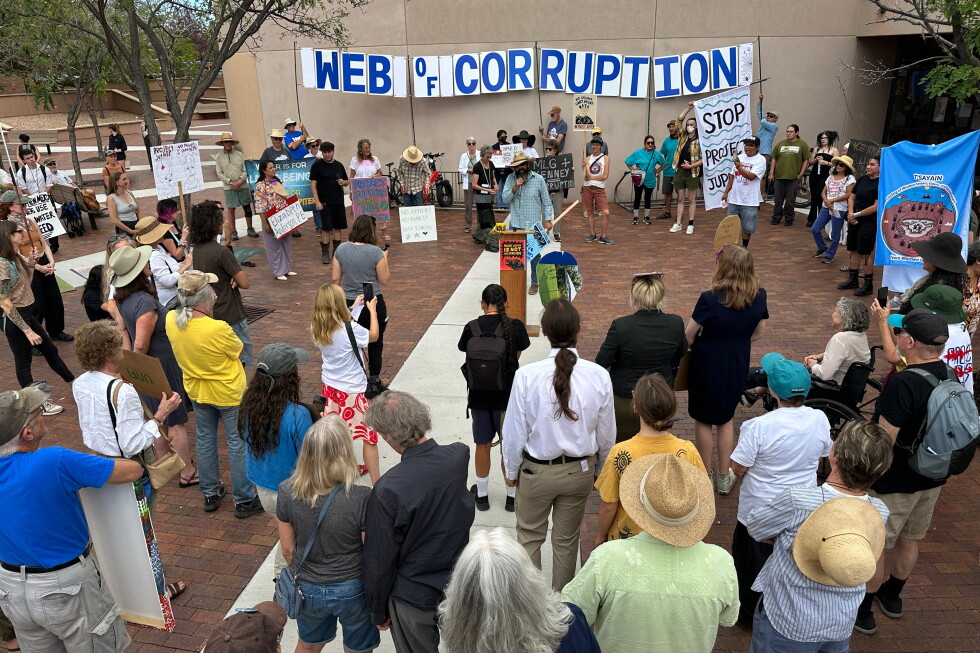
The most visible single project in the current backlash is Project Jupiter in southern New Mexico, a $165 billion data-center complex backed by Oracle and OpenAI, according to the AP’s reporting. Opponents say the project is moving too fast for a region already anxious about drought, groundwater depletion and the long-term health of local agriculture. They have pressed regulators and lawmakers to slow down approvals and have taken their case to public demonstrations, including a protest outside the New Mexico Environment Department in Santa Fe last week.
The state-level dispute has also moved into the courts and regulatory process. According to the AP and local reporting, the Center for Biological Diversity filed an emergency petition challenging state approval of well drilling meant to supply water for the project, and the New Mexico Supreme Court temporarily halted authorization for use of water from a new well while the legal fight continues. That does not end the project, but it underscores how environmental questions are becoming central to whether these facilities can be built at all. For opponents, the issue is not only environmental protection; it is whether a project of this scale can be reconciled with a drought-prone state whose residents already face pressure to conserve water. ([apnews.com](https://apnews.com/article/a419be82fb6b32a8fc048ac7ffbd1de3?utm_source=openai))
Why water and power have become the key arguments
Data centers have become a symbol of a broader resource squeeze because they require huge amounts of electricity and, in many designs, significant water for cooling. Critics say those demands can raise local rates, force expensive infrastructure upgrades and create competition with households, farms and other businesses. Supporters counter that companies are increasingly using more efficient systems and that the projects bring tax revenue, construction spending and long-term employment. In New Mexico, Oracle has said Project Jupiter is intended to generate billions in tax revenue and thousands of jobs while using relatively little water over time through closed-loop cooling and fuel-cell systems, according to AP reporting.
What makes the argument politically potent is that people do not have to reject artificial intelligence itself to oppose the facilities. Many opponents say they are not against technology, but against the way the industry is pursuing it: quickly, quietly and often before communities understand what is being proposed. That message has resonated with residents who believe they are being asked to accept major land-use and utility changes without enough public disclosure or bargaining power. Industry advocates, by contrast, say the U.S. needs the infrastructure to remain competitive and to keep pace with global rivals, especially China, in the race to dominate AI. ([apnews.com](https://apnews.com/article/a419be82fb6b32a8fc048ac7ffbd1de3?utm_source=openai))
Politics is changing around the projects
The backlash is now influencing elected officials well beyond city councils and county commissions. The AP reported that the issue has become visible in midterm politics, with candidates and officeholders adjusting their positions as local anger mounts. In some states, officials have already moved to pause or restrict new data-center development; in others, lawmakers are proposing transparency rules, community-notification requirements and limits on water and power use. That pattern suggests the issue could evolve from a series of isolated land-use disputes into a broader regulatory agenda.
There are signs that the political language is shifting too. Even some conservative leaders who might normally back large infrastructure projects are acknowledging the anger. In recent remarks reported by AP and other outlets, Texas Gov. Greg Abbott argued that some companies had brought backlash on themselves by failing to work closely with communities. At the same time, President Donald Trump has defended data centers as a source of jobs and economic strength, making the issue a test of how pro-growth Republicans will balance industrial expansion against local resistance. The split leaves politicians trying to answer a basic question: how much say should a small community have when a giant company wants to build the backbone of the AI economy there? ([apnews.com](https://apnews.com/article/e5a350af1bc12e6a4f470d3b68be51d7?utm_source=openai))
A broader warning for the AI economy
The current wave of opposition could slow development, increase project costs and make financing harder. Reuters has reported that lenders are beginning to scrutinize data-center deals more closely as community resistance grows. That matters because the scale of AI investment is enormous, and projects can require years of permitting, land assembly and utility planning before construction even begins. If local governments impose moratoriums, demand more disclosure or reject projects outright, developers may be forced to redesign the rollout of AI infrastructure state by state rather than relying on rapid national expansion.
For communities, however, the debate is about more than the pace of innovation. It is about who bears the burden of digital growth and who benefits from it. Rural counties want jobs, but not if they come with depleted water tables or a transformed landscape. Environmental advocates want cleaner energy and stronger public oversight. Labor groups want work opportunities that can keep younger residents from leaving. Tech firms want speed. That collision is why the backlash is spreading: it gives residents a language for saying that AI may be global, but the data centers that power it are very local. And when a local community feels it is paying the bill for a global boom, resistance is likely to keep growing. ([marketscreener.com](https://www.marketscreener.com/news/lenders-scrutinize-us-data-center-financing-as-community-opposition-builds-ce7f50d3d18af226?utm_source=openai))
Sources: