Key facts
- The Standard reported that Nalitex Limited’s listed Nairobi office could not be traced and that its postal address linked to businesses associated with President William Ruto’s family. ([standardmedia.co.ke](https://www.standardmedia.co.ke/national/article/2001556462/and-tender-goes-to-rutos-family-linked-to-sh28-billion-police-uniform-deal?utm_source=openai))
- The Daily Nation reported that Nalitex Ltd won one of the lots in the police uniform tender and that Business Registration Service records list Selpha Chesimi Temoi as sole shareholder. ([nation.africa](https://nation.africa/kenya/news/new-police-look-old-questions-over-uniform-tender-5575108?utm_source=openai))
- The Daily Nation said the new uniforms will be worn by about 60,000 general duty officers. ([nation.africa](https://nation.africa/kenya/news/new-police-look-old-questions-over-uniform-tender-5575108?utm_source=openai))
- The tender structure appears to involve multiple lots awarded to different firms. ([nation.africa](https://nation.africa/kenya/news/new-police-look-old-questions-over-uniform-tender-5575108?utm_source=openai))
- The National Police Service has not publicly disclosed the full tender details. ([nation.africa](https://nation.africa/kenya/news/new-police-look-old-questions-over-uniform-tender-5575108?utm_source=openai))
Tender secrecy and a public rollout that raised new questions
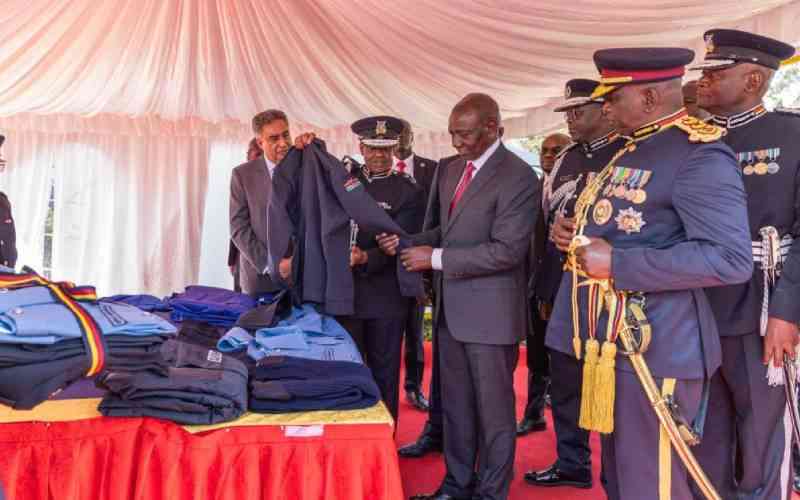
Kenya’s unveiling of a new police uniform was meant to project renewal across the National Police Service, but the programme has instead become the subject of scrutiny over procurement transparency, ownership structures and the role of politically connected business interests. Reporting by The Standard and the Daily Nation indicates that the main supplier, Nalitex Limited, sits at the centre of a tender process that has not been publicly explained in full, even as the new attire has already been presented to the public by President William Ruto at the Kenya Police Training College in Kiganjo. ([standardmedia.co.ke](https://www.standardmedia.co.ke/national/article/2001556462/and-tender-goes-to-rutos-family-linked-to-sh28-billion-police-uniform-deal?utm_source=openai))
The Standard reported that the company’s listed Nairobi office could not be traced and that its postal address was shared with an auditing firm and a property business linked to the president’s family. The Daily Nation independently reported that Nalitex Ltd had been awarded one of the lots in the uniform supply and said Business Registration Service records showed the company was owned by Selpha Chesimi Temoi as sole shareholder. The two reports, while distinct, converge on the same central issue: a high-value security procurement with limited public disclosure and unresolved questions around the contractor’s footprint. ([standardmedia.co.ke](https://www.standardmedia.co.ke/national/article/2001556462/and-tender-goes-to-rutos-family-linked-to-sh28-billion-police-uniform-deal?utm_source=openai))
What the reports say about the company
According to The Standard, Nalitex Limited was incorporated on May 3, 2024, a short time before the new uniforms were unveiled. The newspaper said the company’s office could not be found at the address listed in Nairobi and that the postal address pointed to a location shared by another firm and a property business connected to the first family. Those details do not by themselves prove wrongdoing, but they are the sort of indicators journalists and oversight bodies often examine when reviewing public procurement, especially in security-related contracts where transparency is usually more limited. ([standardmedia.co.ke](https://www.standardmedia.co.ke/national/article/2001556462/and-tender-goes-to-rutos-family-linked-to-sh28-billion-police-uniform-deal?utm_source=openai))
The Daily Nation added that the uniform contract appears to have been split into several lots, with different firms receiving different portions of the work. It said sources indicated one lot went to a company associated with an influential lawmaker and another to a prominent businessman with manufacturing interests. The paper also reported that the National Assembly Committee on Administration and Internal Security was not briefed on the matter in advance and only learned about the new uniform during a budget implementation tour in Kiganjo. ([nation.africa](https://nation.africa/kenya/news/new-police-look-old-questions-over-uniform-tender-5575108?utm_source=openai))
Taken together, the reporting suggests that the uniform procurement was treated as a tightly controlled process rather than a fully open public tender. That does not automatically mean rules were broken, but it does explain why questions are now being asked about how the supplier was selected, why the structure of the deal remains obscure, and whether the public has been given enough information to assess the fairness of the award. ([standardmedia.co.ke](https://www.standardmedia.co.ke/national/article/2001556462/and-tender-goes-to-rutos-family-linked-to-sh28-billion-police-uniform-deal?utm_source=openai))
Why the contract matters politically and financially
The stakes are significant because police uniforms are not a cosmetic purchase. They affect identity, discipline, command visibility and daily working conditions for tens of thousands of officers. The Daily Nation said the uniforms will be worn by about 60,000 general duty officers and that some sources estimate a set could cost Sh25,000, implying a bill of about Sh3 billion for two sets per officer, before adding the cost of boots. Even if the final figures differ, the overall procurement is clearly large enough to attract public scrutiny. ([nation.africa](https://nation.africa/kenya/news/new-police-look-old-questions-over-uniform-tender-5575108?utm_source=openai))
The issue also lands in a politically sensitive environment. In the same reporting, the new uniforms were linked to a presidential showcase at Kiganjo, which means the project is now associated not just with procurement administration but also with the administration’s broader image of reform and delivery. That makes every question about ownership, address verification and tender structure more consequential, because the contract is no longer simply a procurement line item; it has become part of the government’s public narrative on policing and state capacity. ([standardmedia.co.ke](https://www.standardmedia.co.ke/national/article/2001556462/and-tender-goes-to-rutos-family-linked-to-sh28-billion-police-uniform-deal?utm_source=openai))
Kenya’s public procurement system has long faced criticism over secrecy, weak enforcement and the difficulty of tracing beneficial ownership in some tenders. Business Daily has reported in recent weeks that some contractors in government procurement still keep office details opaque, despite reforms that require disclosure of personal and business information for beneficial ownership records. That wider context helps explain why a missing office and a politically adjacent registered address attract intense attention, even before any official investigation is announced. ([businessdailyafrica.com](https://www.businessdailyafrica.com/bd/economy/tycoons-in-half-of-tenders-keep-names-office-secret-5548120?utm_source=openai))
What is known, what is not, and what should happen next
At this stage, the verified facts are limited but important. The Standard says the supplier’s listed office could not be traced and that the postal address overlaps with businesses linked to the president’s family. The Daily Nation says Nalitex Ltd secured one of the lots, that the tender was split, and that the company is owned by Selpha Chesimi Temoi according to registry records. Both outlets agree that the National Police Service has not publicly laid out the full contract details. ([standardmedia.co.ke](https://www.standardmedia.co.ke/national/article/2001556462/and-tender-goes-to-rutos-family-linked-to-sh28-billion-police-uniform-deal?utm_source=openai))
What remains unclear is whether the registered address indicates a substantive business presence, a mail drop, or simply a shared commercial location. It is also unclear whether the company’s incorporation date, ownership structure or premises have any bearing on the award itself. Those are precisely the kinds of questions that should be answered through procurement documents, company registry records, and, if necessary, formal oversight reviews rather than speculation. ([standardmedia.co.ke](https://www.standardmedia.co.ke/national/article/2001556462/and-tender-goes-to-rutos-family-linked-to-sh28-billion-police-uniform-deal?utm_source=openai))
For now, the public record supports a straightforward conclusion: the police uniform tender has become a transparency story. The contract is important enough, and politically close enough to the centre of power, that the absence of clear disclosure will continue to fuel suspicion until the National Police Service, the procurement authorities or relevant parliamentary committees provide a fuller account of who won what, on what basis, and at what cost. ([standardmedia.co.ke](https://www.standardmedia.co.ke/national/article/2001556462/and-tender-goes-to-rutos-family-linked-to-sh28-billion-police-uniform-deal?utm_source=openai))
Broader implications for policing and accountability
The controversy is likely to linger because it touches multiple Kenyan fault lines at once: police reform, state procurement, family-business proximity to politics, and public distrust of major contracts. A uniform may seem mundane compared with weapons, vehicles or digital systems, but it is one of the most visible symbols of the state. If the procurement process around such a symbol is perceived as opaque, the damage extends beyond this one tender and into the credibility of the institutions managing it. ([standardmedia.co.ke](https://www.standardmedia.co.ke/national/article/2001556462/and-tender-goes-to-rutos-family-linked-to-sh28-billion-police-uniform-deal?utm_source=openai))
For Kenya’s global audience, the episode also illustrates a familiar governance challenge in many democracies: when public contracts intersect with politically connected networks, the basic facts of incorporation, addresses and beneficial ownership can become as important as the headline price. In this case, the gap between a polished public launch and the unanswered questions around the supplier is what gives the story its force. Until those gaps are closed, the new police look will continue to invite old questions. ([standardmedia.co.ke](https://www.standardmedia.co.ke/national/article/2001556462/and-tender-goes-to-rutos-family-linked-to-sh28-billion-police-uniform-deal?utm_source=openai))
Image suggestion
A photo of President William Ruto and Inspector-General Douglas Kanja inspecting the new police uniform at Kiganjo, with a secondary image of the uniform set laid out on a neutral background, would fit the story’s focus on public rollout and procurement scrutiny.
Sources: