Key facts
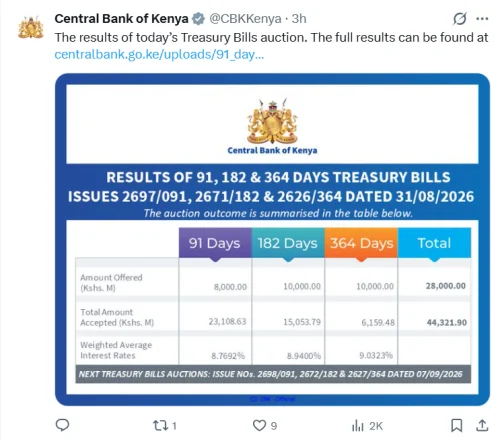
- CBK accepted Sh44.32 billion in Treasury bills after receiving Sh56.74 billion in bids.
- The weekly auction offered Sh28 billion across the 91-day, 182-day and 364-day tenors.
- The 91-day bill attracted Sh23.70 billion in bids and the 182-day bill drew Sh26.88 billion.
- Accepted weighted average rates were 8.7692% for 91 days, 8.9400% for 182 days and 9.0323% for 364 days.
- CBK’s site showed the Central Bank Rate at 8.75% and July 2026 inflation at 6.49%.
- The next Treasury bill auction is scheduled for September 3, 2026, with settlement on September 7, 2026.
Investor demand stays strong for Kenyan short-term debt
The Central Bank of Kenya (CBK) accepted Sh44.32 billion in Treasury bill bids in its latest weekly auction, well above the Sh28 billion it had offered across the 91-day, 182-day and 364-day tenors. Total bids reached Sh56.74 billion, indicating that investors continued to favour government paper despite already elevated participation levels in recent auctions. The auction results were published on August 27, 2026. ([peopledaily.digital](https://peopledaily.digital/business/treasury-bills-attract-ksh56-7b-as-investors-favour-shorter-term-debt/amp))
The latest figures extend a pattern seen in recent weeks, when investors also oversubscribed Treasury bills by a wide margin. In a prior auction reported by People Daily, CBK received bids worth Sh38.5 billion against a smaller weekly offer, while another market report noted even stronger participation in a later sale. Taken together, the results suggest that short-term Kenyan government debt remains a preferred place for cash-rich investors seeking relatively predictable returns. ([peopledaily.digital](https://peopledaily.digital/business/cbk-attracts-ksh38-5b-in-treasury-bills-auction-as-investor-appetite-rises?utm_source=openai))
The 91-day and 182-day papers did most of the work
Demand was concentrated in the shorter maturities. The 91-day Treasury bill drew Sh23.70 billion in bids against Sh8 billion on offer, while the 182-day paper attracted Sh26.88 billion against Sh10 billion. The 364-day bill was the weakest of the three, receiving Sh6.16 billion against a Sh10 billion offer. CBK ultimately accepted Sh23.11 billion from the 91-day instrument, Sh15.05 billion from the 182-day paper and the full Sh6.16 billion from the 364-day bill. ([peopledaily.digital](https://peopledaily.digital/business/treasury-bills-attract-ksh56-7b-as-investors-favour-shorter-term-debt/amp))
That split is consistent with a market that still wants liquidity and flexibility. Shorter-duration securities are easier to roll over, and they expose investors to less interest-rate risk than longer-dated debt. In practice, that means money managers, banks and other institutional buyers can park surplus cash in bills while keeping options open if yields or other market conditions change. This is an interpretation of the auction structure, supported by the tenor-by-tenor bidding pattern disclosed by CBK. ([peopledaily.digital](https://peopledaily.digital/business/treasury-bills-attract-ksh56-7b-as-investors-favour-shorter-term-debt/amp))
Yields edged slightly lower but stayed attractive
The weighted average accepted rates came in at 8.7692 percent for the 91-day paper, 8.9400 percent for the 182-day paper and 9.0323 percent for the 364-day bill. Those levels were marginally below the previous auction’s rates, suggesting that demand remained solid enough to keep pricing broadly stable even as the market absorbed another large weekly placement. ([peopledaily.digital](https://peopledaily.digital/business/treasury-bills-attract-ksh56-7b-as-investors-favour-shorter-term-debt/amp))
CBK’s own website listed the 91-day Treasury bill yield at 8.769 percent on August 27, 2026, almost identical to the auction result reported by People Daily. The bank also showed the Central Bank Rate at 8.75 percent, with inflation at 6.49 percent for July 2026. That backdrop helps explain why government paper continues to attract buyers: the short end of the curve still offers a return premium over policy rates and a margin above inflation. ([centralbank.go.ke](https://www.centralbank.go.ke/))
What the auction means for the government’s funding needs
Of the Sh44.32 billion accepted, Sh26.29 billion was earmarked to refinance maturing securities, according to the auction notice as reported by People Daily. The remainder represented new borrowing or net repayment across the three tenors, with the 91-day bill showing an 8.81 billion net borrowing/net repayment figure, the 182-day bill showing Sh14.25 billion, and the 364-day bill showing a Sh5.03 billion net borrowing/net repayment position. ([peopledaily.digital](https://peopledaily.digital/business/treasury-bills-attract-ksh56-7b-as-investors-favour-shorter-term-debt/amp))
That distinction matters because Treasury bill auctions do more than raise fresh cash: they also manage rollover risk. When a large share of proceeds is used to redeem maturing obligations, the headline size of the auction can overstate the amount of genuinely new financing. Still, a successful oversubscribed sale gives the government flexibility and signals that domestic funding remains available at scale. This is an inference from the auction breakdown and CBK’s stated use of proceeds. ([peopledaily.digital](https://peopledaily.digital/business/treasury-bills-attract-ksh56-7b-as-investors-favour-shorter-term-debt/amp))
Why investors keep showing up
Kenya’s government securities market has remained busy through August. Business Daily reported that CBK accepted Sh312 billion in a large infrastructure bond sale earlier in the month after receiving Sh460.4 billion in bids, underscoring a broader trend of investors allocating surplus cash to public debt rather than riskier private-sector opportunities. That appetite appears to carry over to Treasury bills, where weekly auctions continue to attract bids well above the amount offered. ([businessdailyafrica.com](https://www.businessdailyafrica.com/bd/markets/capital-markets/sh460bn-bond-bids-showweak-private-investments-5557028))
For many institutional investors, bills offer a combination of safety, weekly access and relatively competitive returns. CBK’s own securities pages describe Treasury bills as short-term government debt that can be purchased through the central bank’s auction system, and the bank also notes that published auction results are available on its website. The ease of participation and the scale of the government’s issuance calendar likely help explain why demand remains persistent. ([centralbank.go.ke](https://www.centralbank.go.ke/securities/treasury-bills/?utm_source=openai))
The policy backdrop remains steady
The auction also came shortly after CBK left the Central Bank Rate unchanged at 8.75 percent at its August 11, 2026 Monetary Policy Committee meeting. That decision suggests policymakers are comfortable keeping rates steady for now, even as they monitor inflation, credit conditions and the wider economy. CBK’s website said July 2026 inflation stood at 6.49 percent, while its market surveys pointed to generally stable business expectations despite external risks. ([centralbank.go.ke](https://www.centralbank.go.ke/))
That combination of steady policy rates and healthy demand for bills may be one reason investors continue to absorb large weekly offerings without a dramatic jump in yields. It does not mean all borrowing pressures have disappeared, only that the domestic market is still willing to finance government needs at rates that, for now, remain orderly. ([peopledaily.digital](https://peopledaily.digital/business/treasury-bills-attract-ksh56-7b-as-investors-favour-shorter-term-debt/amp))
Outlook for the next auction
People Daily reported that the next Treasury bill auction is scheduled for September 3, 2026, with bids due earlier that day and settlement set for September 7. The new offer remains at Sh28 billion, split evenly across the three standard tenors. If recent results are any guide, demand is likely to remain firm, especially for the 91-day and 182-day papers. ([peopledaily.digital](https://peopledaily.digital/business/treasury-bills-attract-ksh56-7b-as-investors-favour-shorter-term-debt/amp))
For Kenya’s fiscal authorities, the near-term question is not whether domestic investors will show up, but at what price and in which maturities. For investors, the question is whether current short-term yields still justify holding cash in government paper as policy, inflation and liquidity conditions evolve over the coming weeks. Based on the latest auction, the answer so far is yes. ([peopledaily.digital](https://peopledaily.digital/business/treasury-bills-attract-ksh56-7b-as-investors-favour-shorter-term-debt/amp))
Sources: