Key facts
- President William Ruto is scheduled to unveil the new police uniform on Friday, August 28, 2026, at Kiganjo during a pass-out parade for more than 6,000 recruits. ([standardmedia.co.ke](https://www.standardmedia.co.ke/amp/crime-and-justice/article/2001556209/president-ruto-to-unveil-new-police-uniform-on-friday?utm_source=openai))
- Inspector General Douglas Kanja has said the new uniform will first be worn by graduating general duty officers and then introduced gradually to other general duty officers. ([standardmedia.co.ke](https://www.standardmedia.co.ke/amp/crime-and-justice/article/2001556209/president-ruto-to-unveil-new-police-uniform-on-friday?utm_source=openai))
- The National Police Service says the redesign follows a 2023 public participation exercise in which officers rejected the deep-blue uniform. ([standardmedia.co.ke](https://www.standardmedia.co.ke/amp/crime-and-justice/article/2001556209/president-ruto-to-unveil-new-police-uniform-on-friday?utm_source=openai))
- The Standard reports that the uniform change will cost billions of shillings and has raised concerns about procurement and priorities. ([standardmedia.co.ke](https://www.standardmedia.co.ke/business/national/article/2001556376/hard-questions-as-billions-to-be-spent-on-new-police-uniform?utm_source=openai))
- Earlier Standard coverage showed the uniform plan stalled in 2025 after the 2023 public participation process. ([standardmedia.co.ke](https://www.standardmedia.co.ke/national/article/2001512747/officers-left-in-the-dark-as-plan-to-change-police-uniform-stalls?utm_source=openai))
A fresh uniform, an old argument
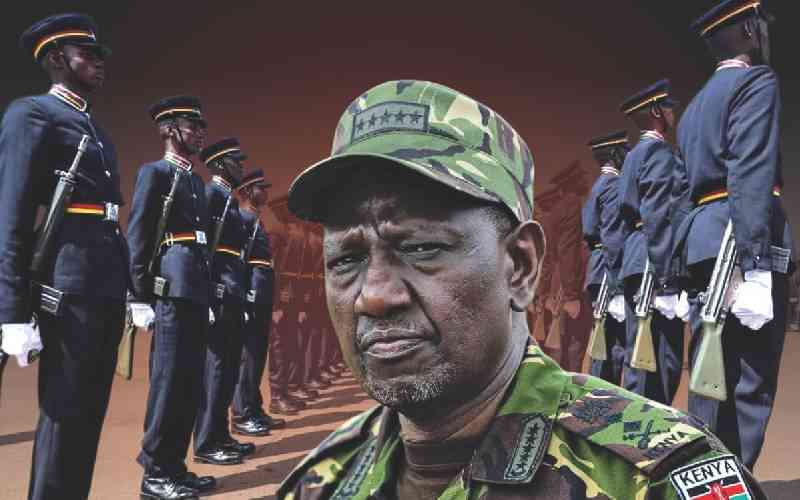
Kenya is once again preparing to change the look of its police service. President William Ruto is scheduled to unveil a new uniform during a passing-out parade at the National Police College in Kiganjo on Friday, August 28, 2026, where more than 6,000 police constables are expected to graduate. The new attire is intended to be introduced first to the graduating officers and then rolled out gradually to other general duty officers in the Kenya Police Service. The Inspector General, Douglas Kanja, has said the change is meant to improve morale and service delivery. ([standardmedia.co.ke](https://www.standardmedia.co.ke/amp/crime-and-justice/article/2001556209/president-ruto-to-unveil-new-police-uniform-on-friday?utm_source=openai))
But the announcement has also revived a familiar Kenyan debate: whether changing the uniform of a security service addresses the real problems facing that service, or merely creates a costly symbol of renewal. The Standard’s reporting frames the issue as one of misplaced priority, noting that billions of shillings are expected to be spent on the overhaul even as broader police reforms remain contested. That tension matters because uniforms are visible, while the deeper issues in policing — public trust, discipline, professionalism, pay, equipment and accountability — are less photogenic but far more consequential. ([standardmedia.co.ke](https://www.standardmedia.co.ke/business/national/article/2001556376/hard-questions-as-billions-to-be-spent-on-new-police-uniform?utm_source=openai))
What is known about the plan
The available reporting is consistent on several core facts. The new uniform is being unveiled at Kiganjo during the parade for 6,000 newly trained constables. General duty officers are the main group expected to adopt it first, while officers in the Administration Wing and the General Service Unit will keep their current uniforms. Kanja has linked the redesign to an earlier public participation process in 2023, when officers rejected the deep-blue uniform then in use. ([standardmedia.co.ke](https://www.standardmedia.co.ke/amp/crime-and-justice/article/2001556209/president-ruto-to-unveil-new-police-uniform-on-friday?utm_source=openai))
Standard Media’s earlier coverage shows that the uniform debate did not begin this week. In 2023, the National Police Service unveiled proposed designs and opened public participation on colours, and by early 2025 the paper reported that the plan had stalled, with officers left unclear about when any change would happen. That history suggests the current launch is not a sudden innovation but the culmination of a long, uneven process that has already involved consultation, delay and reversal. ([standardmedia.co.ke](https://www.standardmedia.co.ke/the-standard/article/2001480407/new-proposed-police-uniforms-unveiled?utm_source=openai))
Why critics are sceptical
The scepticism surrounding the move is not just about aesthetics. It is rooted in a broader suspicion that major state announcements often lean toward visible branding projects rather than structural change. The Standard’s analysis of the issue argues that citizens are asking practical questions about procurement: who is making the fabric, where it is coming from, how much it costs and who benefits from the contract. Those questions are especially relevant in a country where public procurement controversies have repeatedly shaped debates around government spending. ([standardmedia.co.ke](https://www.standardmedia.co.ke/business/national/article/2001556376/hard-questions-as-billions-to-be-spent-on-new-police-uniform?utm_source=openai))
That criticism is amplified by the timing. The police service has faced sustained scrutiny in recent years over discipline, professionalism and public trust. Standard Media has previously reported on concerns about officers wearing camouflage uniforms in situations where they were not authorised, and on the long-running search for a police identity that commands respect. Even if the new attire is cleaner or more practical, a new look alone cannot solve problems of command culture, rights violations or weak supervision. That is an inference based on the reporting and on the broader reform debate, not a claim that the uniform change itself is ineffective. ([standardmedia.co.ke](https://www.standardmedia.co.ke/national/article/2001523033/blatant-defiance-uniform-scandal-that-is-eroding-police-discipline?utm_source=openai))
Reform is more than appearance
Kanja’s argument is straightforward: a better-fitting image can improve morale, and morale can improve service. That may be true, but it is only one part of the policing equation. A uniform can help officers feel part of a professional institution; it cannot by itself fix poor working conditions, inadequate logistics, allegations of abuse or the public’s memory of heavy-handed policing during protests and other security operations. The newest reporting also comes against a backdrop of wider reform measures in the National Police Service, including changes to the standing orders and the service structure published in July 2026. ([standardmedia.co.ke](https://www.standardmedia.co.ke/amp/business/national/article/2001554236/ig-kanjas-powers-expanded-in-new-police-reforms?utm_source=openai))
In that sense, the uniform launch is a test of whether the government’s public-facing changes are being matched by institutional ones. If the new attire is accompanied by clearer accountability, better training, improved mobility, respectful engagement with the public and proper procurement oversight, it may be remembered as part of a genuine modernisation effort. If it becomes merely a symbolic reset, then critics are likely to conclude that the country has once again dressed up an old problem. That conclusion is an editorial assessment, not a sourced fact, but it follows from the concerns voiced in the reporting. ([standardmedia.co.ke](https://www.standardmedia.co.ke/business/national/article/2001556376/hard-questions-as-billions-to-be-spent-on-new-police-uniform?utm_source=openai))
The political and public stakes
For President Ruto, the Kiganjo event offers a highly visible platform to present his administration as supportive of the police service. For police leadership, it is an opportunity to signal a fresh institutional identity to recruits and the public. But the success of such a move will be judged not by the ceremony itself, but by what happens after the cameras leave. Kenyans will be watching to see whether the new uniform is rolled out smoothly, whether procurement is transparent and whether the service can deliver the kind of policing that feels safer, more professional and more accountable. ([standardmedia.co.ke](https://www.standardmedia.co.ke/amp/crime-and-justice/article/2001556209/president-ruto-to-unveil-new-police-uniform-on-friday?utm_source=openai))
The symbolism is powerful because police uniforms carry authority in a way few state garments do. A redesign can therefore be politically attractive: it is easy to see, easy to announce and easy to photograph. Yet the same visibility can become a liability if citizens conclude that the state is investing in image rather than substance. The real story, then, is not simply that the police are changing clothes. It is whether Kenya is changing the way it polices. That is the core question raised by the reporting and by the broader history of the uniform debate. ([standardmedia.co.ke](https://www.standardmedia.co.ke/national/article/2001512747/officers-left-in-the-dark-as-plan-to-change-police-uniform-stalls?utm_source=openai))
Bottom line
The new police uniform is real, and the rollout is imminent. So are the questions about cost, procurement and reform. The government can legitimately argue that a professional service should look the part. Critics can just as legitimately ask whether appearance is being prioritised ahead of accountability. Both positions are supported by the reporting; the difference is that one sees a necessary refresh, while the other sees a familiar distraction. ([standardmedia.co.ke](https://www.standardmedia.co.ke/business/national/article/2001556376/hard-questions-as-billions-to-be-spent-on-new-police-uniform?utm_source=openai))
Sources: