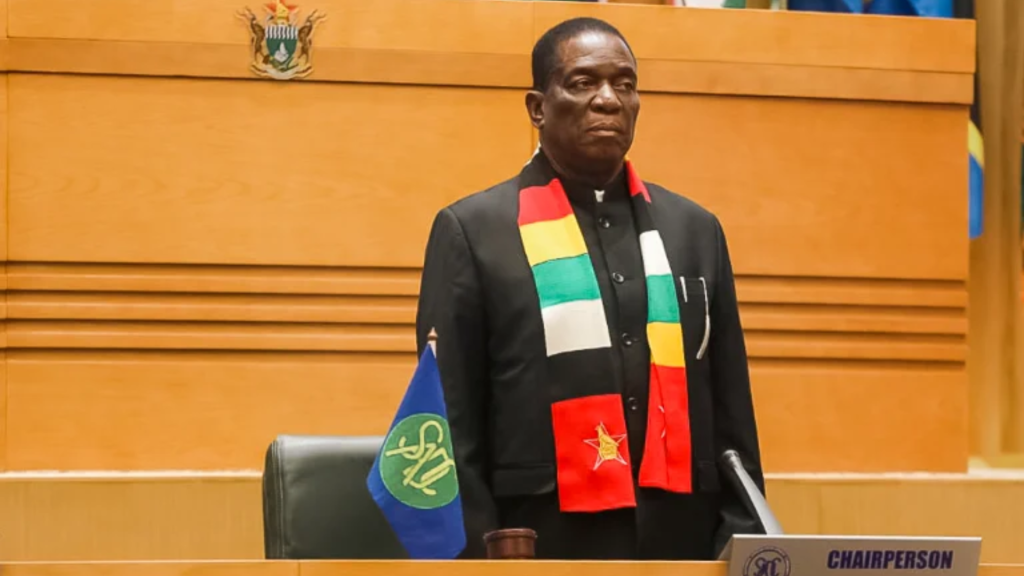
Zimbabwe’s cabinet has approved draft constitutional amendments that would enable President Emmerson Mnangagwa to remain in power until at least 2030 by shifting the election of the president from a direct popular vote to a ballot by Members of Parliament.
The proposed changes, announced following a cabinet meeting on February 4, 2026, would also introduce a maximum of two seven-year presidential terms, replacing the current two five-year term limit under the 2013 Constitution.
Information Minister Jenfan Muswere confirmed the decision after the weekly cabinet briefing in Harare. “The cabinet has approved the draft Bill for the amendment of the Constitution to align with the Second Republic’s vision of a more stable and predictable political environment,” Muswere said. “The president will now be elected by Parliament, which is composed of directly elected representatives of the people. This ensures that the choice reflects the collective will of the nation.”
The amendments, if passed, would allow Mnangagwa—who is currently serving his second and final five-year term after winning the 2023 election—to seek a fresh seven-year term under the new rules. This would potentially extend his tenure until 2030 or beyond, depending on the timing of the parliamentary vote.
Under the current constitution, Mnangagwa is barred from running again in 2028. The proposed shift to an indirect election system would reset the term clock and allow him—or a designated successor—to serve additional years.
Critics immediately condemned the move as a power-retention scheme. The main opposition party, Citizens Coalition for Change (CCC), described the amendments as “a blatant attempt to entrench authoritarian rule.” CCC spokesperson Promise Mkwananzi said: “Mnangagwa is trying to rewrite the constitution to stay in power forever. Zimbabweans rejected this in 2000 and 2013. We will not accept it now.”
Civil society organisations have raised alarm over the implications for democratic accountability. The Zimbabwe Human Rights NGO Forum said in a statement: “Moving presidential elections from the people to Parliament removes the direct mandate of citizens and concentrates power in the hands of political elites. This is a dangerous regression.”
The draft laws also propose changes to the composition of Parliament, including increasing the number of proportional representation seats and adjusting delimitation processes. These changes are expected to be tabled in Parliament in the coming weeks, where ZANU-PF holds a commanding majority.
Government spokesperson Nick Mangwana defended the amendments as necessary for stability. “The current system has led to polarisation and instability,” Mangwana said. “An indirect election by MPs will ensure that the president enjoys broad support across the country and reduce the winner-takes-all mentality that has characterised our elections.”
Mnangagwa, who turned 83 in September 2025, has repeatedly denied any intention to extend his rule beyond constitutional limits. However, allies within ZANU-PF have openly called for him to stay longer, citing the need for continuity in economic reforms and national stability.
The proposed seven-year term limit has been framed as a move toward longer, more stable leadership periods. “Seven years allows a president to implement meaningful change without the distraction of constant campaigning,” Muswere said. “Two terms of seven years is sufficient for any leader to deliver.”
The amendments would require a two-thirds majority in both houses of Parliament and a national referendum to be passed into law. ZANU-PF currently holds more than the required threshold in the National Assembly and Senate, but analysts say the referendum will be the real battleground.
The Zimbabwe Election Support Network (ZESN) has warned that any rushed or manipulated referendum would undermine public trust. “The people must be given a genuine opportunity to decide,” ZESN director Ezekiel Mafume said. “We will monitor the process closely to ensure it is free and fair.”
The announcement has reignited debate over Mnangagwa’s succession plans. Vice Presidents Constantino Chiwenga and Kembo Mohadi are widely seen as potential successors, but Mnangagwa has not publicly anointed anyone. Some analysts believe the term extension is a way to buy time while grooming a preferred candidate.
The opposition has vowed to challenge the amendments at every stage. “We will mobilise the people to reject this power grab,” Mkwananzi said. “Zimbabweans have seen this movie before. They will not allow it to end the same way.”
As Parliament prepares to debate the Bill, the coming months are expected to see heightened political activity, legal challenges and public protests. The outcome will shape not only Mnangagwa’s legacy but the future direction of Zimbabwe’s democracy.