By Brenda Wereh28 Jul, 202539 mins read 2,332 views
0 comments 0 likes
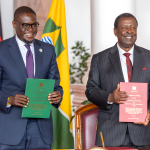
President William Ruto and Ethiopian PM Abiy Ahmed held high-level talks to enhance bilateral cooperation ahead of the 2025 UN Food Systems Summit in Addis Ababa.
President William Ruto of Kenya arrived in Addis Ababa, Ethiopia, to attend the Second United Nations Food Systems Summit Stocktake (UNFSS+4), a pivotal global platform aimed at reviewing progress on transforming food systems for sustainability and resilience. Welcomed at Bole International Airport by Ethiopia’s Deputy Prime Minister Temesgen Tiruneh, Ruto’s visit marked not only Kenya’s commitment to global food security but also a significant moment in Kenya-Ethiopia relations. On the sidelines of the summit, President Ruto held bilateral talks with Ethiopian Prime Minister Abiy Ahmed at the National Palace, focusing on strengthening ties between the two East African neighbors and addressing regional challenges. These discussions, rooted in a history of diplomatic and economic cooperation, underscored the strategic importance of their partnership in advancing food security, trade, infrastructure, and regional stability.
The Second United Nations Food Systems Summit Stocktake, co-hosted by Ethiopia and Italy from July 27 to 29, 2025, brought together world leaders, policymakers, and stakeholders to assess progress since the inaugural 2021 summit. The UNFSS+4 aimed to address pressing challenges in global food and nutrition security, particularly in developing nations, amid crises such as climate change, conflict, and economic instability. Ethiopia, as a co-host, reaffirmed its commitment to sustainable and resilient food systems, with Prime Minister Abiy Ahmed emphasizing integrated policies and climate-smart agriculture to improve food security outcomes across Africa.
President Ruto, a vocal advocate for food system reforms, used the summit to deliver Kenya’s national statement, highlighting the country’s dedication to sustainable development and climate resilience. Kenya has been at the forefront of championing climate adaptation initiatives in Africa, and Ruto’s participation underscored Nairobi’s ambition to lead in shaping the global food security agenda. His address emphasized the need for collective action to build food systems capable of withstanding environmental and socio-economic challenges, a message that resonated with Ethiopia’s own priorities under Abiy’s leadership.
The summit provided a critical backdrop for Ruto and Abiy’s bilateral discussions, as food security is a shared priority for both nations. Kenya and Ethiopia face similar challenges, including drought, rising food prices, and the need for enhanced agricultural productivity. Their talks, therefore, extended beyond diplomacy to practical cooperation in agriculture, trade, and infrastructure, leveraging the summit’s momentum to deepen their partnership.
Kenya and Ethiopia share a long history of diplomatic and economic ties, underpinned by their roles as anchor states in the volatile Horn of Africa. Their relationship has been shaped by mutual interests in regional stability, trade, and infrastructure development, though not without challenges. Historical border disputes, Ethiopia’s civil conflict in Tigray, and its controversial 2024 memorandum of understanding with Somaliland over port access have occasionally strained ties. However, recent years have seen a concerted effort to strengthen cooperation, as evidenced by Abiy’s state visit to Nairobi in February 2024 and Ruto’s reciprocal engagements.
During Abiy’s 2024 visit, the two leaders signed seven agreements under the Joint Ministerial Commission Meeting, a bilateral framework dormant for seven years prior. These agreements focused on trade, investment, agriculture, tourism, health, fisheries, and transport, reflecting a broad commitment to economic integration. Notably, they exempted Ethiopian visitors from fees under Kenya’s electronic travel authorization system, boosting people-to-people interactions. In 2023, bilateral trade reached $501 million, with Kenya exporting $276 million worth of goods to Ethiopia and importing $225 million, signaling a growing economic partnership.
Earlier engagements, such as Ruto’s 2022 visit to Addis Ababa, further solidified ties. A key outcome was an agreement allowing Kenya to import wheat from Ethiopia to stabilize food prices amid global supply chain disruptions. This deal, part of broader discussions on food security, highlighted the practical benefits of their cooperation. The 2012 Special Status Agreement between the two nations continues to serve as a foundation for their strategic partnership, facilitating collaboration in areas like the Lamu Port-South Sudan-Ethiopia Transport (LAPSSET) corridor, a regional infrastructure project aimed at enhancing trade connectivity.
The July 27, 2025, meeting between Ruto and Abiy at the National Palace in Addis Ababa focused on deepening bilateral relations and addressing regional issues of mutual interest. According to a statement by Abiy on X, the discussions were timely, aligning with the continent’s efforts to build resilient food systems and tackle shared challenges like climate change and insecurity. Ruto’s delegation, supported by State House spokesperson Hussein Mohamed, emphasized that the talks centered on strengthening ties, deepening regional integration, and enhancing cooperation in food security, trade, infrastructure, climate action, and multilateral diplomacy.
Food security emerged as a cornerstone of the discussions, reflecting the summit’s agenda and the pressing needs of both nations. Ethiopia has made significant strides in agricultural productivity, particularly in wheat, with Abiy noting in a February 2025 meeting with the FAO Director-General that Ethiopia aims to become Africa’s top exporter of wheat, coffee, and tea within three years. Kenya, meanwhile, has prioritized climate-smart agriculture to combat food insecurity exacerbated by drought and global price volatility. The 2022 wheat import agreement was a testament to their shared commitment to stabilizing food prices and ensuring supply chain resilience.
During the 2025 talks, Ruto and Abiy likely explored further opportunities for agricultural trade and knowledge sharing. Ethiopia’s advancements in climate-smart farming, supported by initiatives like the Beautifying Sheger project, offer lessons for Kenya’s own efforts to enhance agricultural resilience. Conversely, Kenya’s expertise in agribusiness and cooperative farming models could benefit Ethiopia’s community-driven approaches. The leaders’ focus on food security aligns with the UNFSS+4’s goals, positioning Kenya and Ethiopia as regional leaders in transforming food systems.
Trade and infrastructure were key pillars of the bilateral talks, building on previous agreements. The LAPSSET corridor, which aims to connect Kenya’s port of Lamu to Ethiopia and South Sudan, remains a flagship project for regional integration. Although progress has been slow since its inception in 2012, renewed commitment from both leaders could revitalize the initiative, providing Ethiopia with critical sea access and boosting Kenya’s role as a regional trade hub. The 2024 agreements on transport and ICT cooperation further underscore the potential for enhanced connectivity, with projects like the Moyale One-Stop Border Post facilitating smoother cross-border trade.
The Horn of Africa’s geopolitical complexities, including Ethiopia’s internal conflicts and tensions with Somalia over the Somaliland port deal, were likely addressed during the talks. Both leaders have consistently affirmed their commitment to regional stability, as seen in their 2024 joint communique emphasizing sovereignty and territorial integrity. Kenya’s peacemaking efforts in Ethiopia’s Tigray conflict have bolstered its diplomatic standing, while Ethiopia’s role in the African Union Transition Mission in Somalia highlights its contribution to regional security. Ruto and Abiy’s discussions likely reinforced their pledge to collaborate on countering threats like Al-Shabaab, as demonstrated in their 2023 Mogadishu meeting during the Somalia-Frontline States Summit.
Climate action was another focal point, given both countries’ vulnerability to climate change and their leadership in regional climate initiatives. Ethiopia’s Green Legacy Initiative and Kenya’s ambitious tree-planting campaigns reflect shared priorities in environmental sustainability. The leaders likely discussed aligning their efforts to access global climate financing and implement climate-resilient agricultural practices, a key theme of the UN Food Summit. Their multilateral diplomacy also extended to supporting regional institutions like the African Union, with Ruto engaging AU Commission Chairperson Mahamoud Ali Youssouf on the sidelines of the summit to advance Kenya’s diplomatic agenda, including support for Raila Odinga’s AU Commission candidacy.
Despite the positive trajectory of Kenya-Ethiopia relations, challenges remain. Ethiopia’s 2024 Somaliland deal has created tensions with Somalia, complicating regional dynamics. Kenya, balancing its role as a regional mediator, must navigate these tensions carefully to maintain its neutral stance. Additionally, Ethiopia’s internal conflicts and democratic backsliding, as noted by Freedom House, pose risks to its stability, which could impact bilateral cooperation. The FAO’s controversial 2024 Agricola Medal award to Abiy, amid reports of food insecurity in Tigray, highlights the complexities of Ethiopia’s domestic challenges.
Nevertheless, the opportunities for deepened ties are substantial. Kenya and Ethiopia’s complementary strengths in agriculture, trade, and infrastructure position them to lead regional integration efforts. Their shared commitment to food security and climate resilience aligns with global priorities, offering a platform to attract investment and technical assistance from partners like the FAO and the African Union. The LAPSSET corridor, if fully realized, could transform the region’s economic landscape, while continued collaboration on security could enhance stability in the Horn of Africa.
The Ruto-Abiy meeting underscores the strategic importance of Kenya-Ethiopia relations in shaping the Horn of Africa’s future. As anchor states, their partnership sets a precedent for regional cooperation in addressing food insecurity, climate change, and geopolitical challenges. The UNFSS+4 provided a global stage to amplify their shared vision, positioning them as leaders in the African Union’s Agenda 2063 for sustainable development.
For Kenya, the summit and bilateral talks reinforced President Ruto’s role as a regional peacemaker and advocate for food systems reform. For Ethiopia, hosting the summit and engaging with Ruto highlighted Prime Minister Abiy’s ambition to lead Africa’s food security agenda despite domestic challenges. Together, their collaboration could drive transformative change, not only in their bilateral relations but also in the broader East African Community and African Union frameworks.
The July 27, 2025, bilateral meeting between President William Ruto and Prime Minister Abiy Ahmed ahead of the UN Food Systems Summit marked a significant step in deepening Kenya-Ethiopia ties. Rooted in a shared commitment to food security, trade, infrastructure, and regional stability, their discussions leveraged the summit’s momentum to advance practical cooperation. While challenges like regional tensions and Ethiopia’s internal conflicts persist, the opportunities for economic integration and climate action are immense. As Kenya and Ethiopia continue to navigate the complexities of the Horn of Africa, their partnership remains a cornerstone of regional progress, with implications that extend far beyond their borders.
Former Kiambu Governor Ferdinand Waititu has secured a major bail reprieve from the High Court, with Justice Winfrida Okwany reducing his bail from Sh53.5 million to Sh20 million cash pending appeal in his ongoing corruption case.
Kenya National Highways Authority names Eng. Luka Kipchumba Kimeli as Director General while Kenya Roads Board appoints Judith Otsyula to the same role in major leadership changes for Kenya's roads sector.
Kenya’s Committee on Communication, Information and Innovation has rejected calls for a complete ban on TikTok, instead proposing mandatory local storage of Kenyan user data and full compliance with national laws in a report adopted for debate in the National Assembly.