Kenya’s President William Ruto welcomed Uganda’s President Yoweri Museveni to Nairobi for high-level bilateral talks focusing on regional trade, infrastructure, and security cooperation.
Nairobi’s State House became the epicenter of East African diplomacy as Kenyan President William Ruto welcomed his Ugandan counterpart, President Yoweri Museveni, for a high-stakes official visit aimed at recalibrating the delicate balance of economic ambitions and regional cooperation. This pivotal meeting, steeped in both promise and tension, underscores the enduring yet complex relationship between Kenya and Uganda—two nations bound by geography, history, and shared aspirations for a stronger East African Community (EAC).
The visit, announced through vibrant posts on X and official channels, has sparked widespread buzz across the region, with analysts and citizens alike dissecting its implications for trade, security, and political stability in East Africa.
The arrival of President Museveni in Nairobi was marked by ceremonial grandeur, including a 21-gun salute, a gesture symbolizing Kenya’s commitment to strengthening ties with its western neighbor. Museveni, often referred to by Ruto as the “father of the region,” was received at Jomo Kenyatta International Airport by a high-level delegation led by Kenya’s Prime Cabinet Secretary and Minister for Foreign and Diaspora Affairs, Musalia Mudavadi. The optics of the visit, carefully curated and shared across platforms like X, signaled a renewed effort to mend and fortify bilateral relations that have, at times, been strained by trade disputes and differing regional priorities.
The backdrop of this visit is a region at a crossroads. Kenya and Uganda, both linchpins of the EAC, face mounting economic pressures, from rising inflation to youth unemployment, alongside the ever-present need for regional stability amidst conflicts in neighboring countries like the Democratic Republic of Congo (DRC) and South Sudan. Posts on X, such as those from @StateHouseKenya and @KagutaMuseveni, highlighted the leaders’ intent to “strengthen the bond” between their nations, with Museveni’s tweet emphasizing collaborative efforts to unlock mutual benefits.
At the core of the bilateral discussions is the pressing need to streamline trade and remove longstanding bottlenecks that have hindered economic integration. Kenya and Uganda share a robust trade relationship, with Uganda relying heavily on Kenya’s Mombasa port for petroleum imports, valued at KSh 208 billion in 2022 alone. However, disputes over fuel importation protocols have previously soured relations, most notably when Kenya’s policies threatened to block Uganda’s National Oil Company from direct imports, prompting Kampala to file a case at the regional Court of Justice.
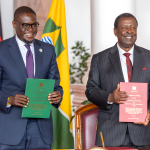
The recent signing of a tripartite agreement between Kenya’s Ministry of Energy and Petroleum, its Ugandan counterpart, and the Uganda National Oil Company has been hailed as a breakthrough. This deal, formalized during Museveni’s May 2024 visit to Nairobi, aims to eliminate trade barriers and foster a seamless flow of petroleum products. The July 2025 talks are expected to build on this momentum, with both leaders exploring new avenues for investment, particularly in infrastructure and small and medium enterprises (SMEs). Seven memoranda of understanding (MoUs) signed during the second session of the Joint Ministerial Commission (JMC) in May 2024—in areas like public service management, education, sports, youth, trade, and investment—set the stage for deeper collaboration.
Ruto’s Bottom-Up Economic Transformation Agenda (BETA) aligns closely with these goals, emphasizing grassroots empowerment and job creation. The Kenyan president has championed initiatives like the Affordable Housing Programme, which has created over 250,000 jobs and seen 720,000 Kenyans register on the Boma Yangu portal. Museveni, a vocal advocate for regional economic integration, echoed these sentiments, stressing the need for a political federation within the EAC to unlock the region’s full potential. His colorful analogy during a previous visit—comparing Uganda’s position in the EAC to being “in the bedroom” while Kenya occupies the “sitting room”—underscored the urgency of dismantling trade barriers to create a truly unified market.
Beyond economics, security cooperation remains a critical pillar of the Kenya-Uganda relationship. The EAC faces persistent challenges, including the ongoing conflict in the DRC and the fragile peace in South Sudan. Both Ruto and Museveni have positioned themselves as regional mediators, with Kenya leading efforts in the Nairobi Process for DRC peace talks and Uganda playing a pivotal role in regional security frameworks. The leaders’ discussions are expected to address the harmonization of these efforts, particularly the merger of the Nairobi and Luanda Processes, which Ruto has argued would reduce diplomatic “forum shopping” and enhance efficiency.
The stakes are high. The collapse of a recent AU Peace and Security Council meeting on the DRC, as reported by sources to Kenyan Foreign Policy, highlighted the challenges of achieving consensus on regional security. Ruto’s efforts to sideline his predecessor, Uhuru Kenyatta, as the EAC-led Nairobi Process facilitator during the AU Summit in February 2025, added a layer of complexity to Kenya’s regional leadership ambitions. Museveni’s visit offers an opportunity to align strategies and present a united front, particularly as Kenya seeks to bolster its diplomatic clout ahead of Raila Odinga’s potential chairmanship of the African Union Commission in 2025.
The timing of Museveni’s visit is significant, as both leaders face domestic pressures that could shape the outcomes of their talks. In Kenya, Ruto is grappling with unprecedented public discontent, with protests in July 2025—sparked by high taxation, corruption allegations, and police brutality—resulting in over 100 deaths and widespread calls for his resignation. The “Ruto Must Go” and “Wantam” (one-term) slogans have gained traction, reflecting a youth-led, leaderless movement that has shaken Ruto’s administration. Analysts, such as Mark Bichachi, describe this public outcry as “unprecedented,” surpassing even the political upheavals of Kenya’s one-party state era under Daniel arap Moi.
Museveni, too, faces challenges at home, with Uganda’s long-serving leader navigating criticism over his autocratic rule and the grooming of his son, General Muhoozi Kainerugaba, as a potential successor. Past tensions, such as Muhoozi’s 2022 tweets threatening to “capture Nairobi,” briefly strained Kenya-Uganda relations, though Museveni’s swift apology and Ruto’s diplomatic visit to Uganda for its 60th independence celebrations helped defuse the situation. The current visit is seen as a chance to move beyond such missteps and focus on shared goals.
The Nairobi talks are not just about Kenya and Uganda but about the future of the EAC as a whole. The community, comprising eight nations, has struggled to fully implement its customs union and common market protocols, with member states like Burundi and Tanzania lagging behind. Museveni’s vision of a political federation, while ambitious, faces resistance from countries wary of ceding sovereignty. Ruto, who has echoed this goal, must balance his domestic priorities with the need to project Kenya as a regional leader, especially as Ethiopia grapples with internal conflicts and Uganda’s democratic credentials come under scrutiny.
Social media sentiment, as seen in posts from @Eastleighvoice and @KeDailyOnline, reflects cautious optimism about the visit’s potential to reset relations. However, analysts warn that tangible outcomes—such as concrete trade agreements or security commitments—will be crucial to sustaining public support. The leaders’ ability to translate diplomatic rhetoric into actionable policies will determine whether this visit marks a turning point or merely another chapter in the region’s complex diplomatic dance.
As Ruto and Museveni engage in high-level discussions, the eyes of East Africa are on Nairobi. The visit, expected to span three days, will likely culminate in a joint communique outlining new commitments in trade, infrastructure, and security. For Ruto, it’s a chance to bolster his regional standing amid domestic challenges, while Museveni aims to cement Uganda’s role as a key player in the EAC’s economic and political future.
The leaders’ personal rapport—evident in Ruto’s warm references to Museveni as an “old friend” and the latter’s signature humor during public addresses—adds a layer of optimism to the proceedings. Yet, the real test lies in execution. With Kenya’s economy under strain and Uganda seeking new trade partners in Asia, as seen in Museveni’s 2022 Vietnam visit, both nations must navigate a global landscape marked by geopolitical competition and economic uncertainty.
In the words of a Kenyan analyst, “This is not just a meeting of two presidents; it’s a litmus test for East Africa’s ability to unite for progress.” As the region watches, the outcomes of these talks could shape the trajectory of Kenya-Uganda relations and the broader EAC for years to come.
Former Kiambu Governor Ferdinand Waititu has secured a major bail reprieve from the High Court, with Justice Winfrida Okwany reducing his bail from Sh53.5 million to Sh20 million cash pending appeal in his ongoing corruption case.
Kenya National Highways Authority names Eng. Luka Kipchumba Kimeli as Director General while Kenya Roads Board appoints Judith Otsyula to the same role in major leadership changes for Kenya's roads sector.
Kenya’s Committee on Communication, Information and Innovation has rejected calls for a complete ban on TikTok, instead proposing mandatory local storage of Kenyan user data and full compliance with national laws in a report adopted for debate in the National Assembly.