By Brenda Wereh23 Jun, 202530 mins read 2,945 views
0 comments 0 likes
An in-depth look at the Orange Democratic Movement’s sharp rebuke of the Standard Newspaper for labeling Raila Odinga a “betrayer of Gen Z” and accusations of a broader propaganda effort.
Kenya’s political discourse took a heated turn on June 23, 2025, as the Orange Democratic Movement (ODM) issued a scathing statement denouncing the Standard Newspaper for what it described as a deliberate campaign of misinformation targeting the party and its leader, Raila Odinga. The press release, signed by ODM Secretary-General Senator Edwin Sifuna, expressed deep frustration over a headline in the day’s edition of the Standard that branded Odinga a “betrayer of the Gen Z,” accusing the media house of orchestrating a sustained effort to discredit the opposition leader. The statement also reaffirmed ODM’s independence from the Kenya Kwanza government, emphasizing that its engagements with the administration are driven by a commitment to peace and development, not political allegiance. This clash between a major political party and one of Kenya’s leading media outlets has sparked widespread debate about press freedom, political narratives, and the role of media in shaping public opinion.
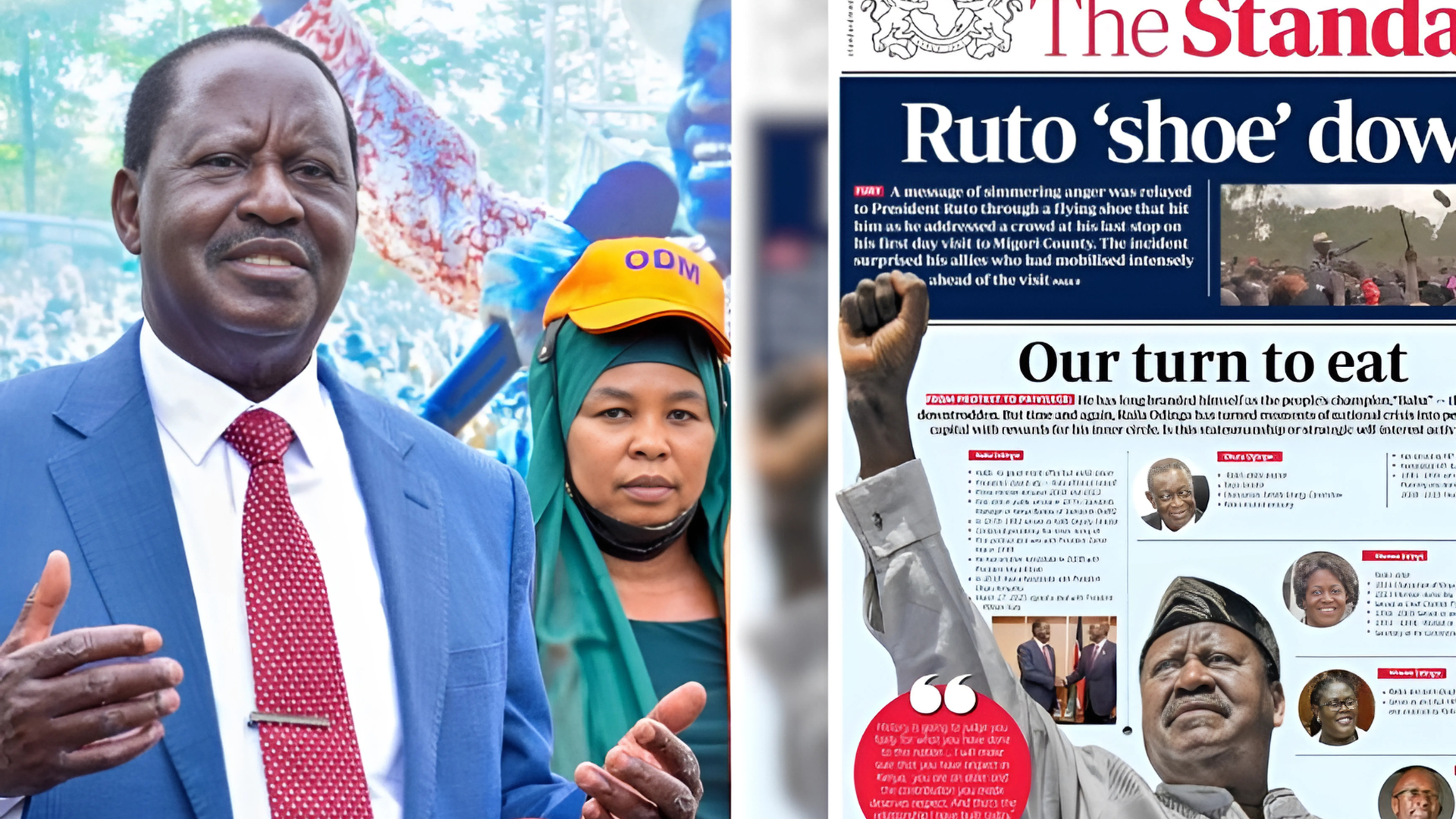
A photo of ODM leader, Raila Amollo Odinga and The Standards Newspaper
The controversy erupted following the Standard’s front-page story, which criticized Odinga’s recent cooperation with President William Ruto’s government, particularly the broad-based agreement signed in March 2025. The headline, “Raila: Betrayer of the Gen Z,” suggested that Odinga had abandoned the youth-led protests that rocked Kenya in 2024, particularly those driven by Generation Z activists opposing government policies like tax hikes and the Finance Bill. The article argued that Odinga’s decision to engage with Kenya Kwanza contradicted his earlier support for the protests, alienating young Kenyans who saw him as a champion of their cause. ODM’s response was swift and unequivocal, dismissing the headline as inflammatory and accusing the Standard of distorting facts to serve a hidden agenda.
“We are deeply disappointed by the Standard Newspaper’s continued campaign of misinformation against our party and our leader, H.E. Raila Odinga,” Sifuna stated in the press release. “Labeling him a ‘betrayer of the Gen Z’ is not only false but a calculated attempt to malign his legacy and sow division among Kenyans.” The statement went further, alleging that the Standard Media Group has been running a “sustained propaganda campaign” aimed at pressuring political leaders to align with the interests of the media house’s ownership. While ODM stopped short of naming specific individuals or entities behind the alleged agenda, the accusation pointed to a broader tension between Kenya’s political class and its influential media sector.
The reference to Generation Z is particularly significant, given their growing influence in Kenyan politics. In 2024, Gen Z activists organized nationwide protests against the Finance Bill, using social media platforms to mobilize and demand accountability. Odinga and ODM publicly supported these demonstrations, with Odinga praising the youth for their courage in holding the government accountable. However, his subsequent engagement with Ruto’s administration, including joint tours in Nyanza and the inclusion of ODM members in key government roles, has drawn criticism from some quarters. “Raila stood with us when we were in the streets, but now he’s dining with the same government we fought,” said Jane Wanjiku, a 22-year-old university student and Gen Z activist in Nairobi. “The Standard’s headline might be harsh, but it’s what some of us feel.”
ODM, however, insists that the Standard’s portrayal is a gross misrepresentation. The party argues that Odinga’s collaboration with the government is a strategic move to promote national stability and address pressing issues like unemployment and healthcare. “Our engagements with the Kenya Kwanza government are not about political alignment but about fostering peace and development for all Kenyans,” Sifuna said. “We remain a distinct opposition party, committed to holding the government accountable while working for the greater good.” The statement highlighted ODM’s push for policies like universal healthcare and youth empowerment, which it claims are part of its dialogue with the administration.
The accusation of a media-driven agenda adds another layer to the dispute. ODM’s press release suggested that the Standard’s coverage reflects an attempt to coerce political leaders into serving corporate or political interests tied to the media house. “This is not journalism; it’s manipulation,” Sifuna declared during a follow-up interview on a local radio station. “The Standard is trying to dictate the political direction of this country by tarnishing those who don’t toe their line.” Such claims resonate with a segment of the public skeptical of media impartiality, particularly in a country where media houses have historically been linked to political factions.
The Standard, for its part, has yet to respond formally to ODM’s accusations, though a senior editor, speaking anonymously, defended the newspaper’s reporting. “Our job is to hold all leaders accountable, regardless of their political affiliation,” the editor said. “The story reflected public sentiment, particularly among young Kenyans who feel let down.” The newspaper’s silence in the face of ODM’s public condemnation has only fueled speculation about its motives, with some analysts suggesting the outlet may be navigating pressure from both political and commercial stakeholders.
The clash underscores deeper tensions in Kenya’s media landscape, where outlets like the Standard, Nation, and KTN compete to shape narratives in a highly polarized environment. “Media houses in Kenya are powerful players,” said political analyst John Mwangi. “They can amplify or destroy a politician’s image, and parties like ODM are acutely aware of this.” Mwangi noted that ODM’s strong response may be a preemptive strike to counter negative coverage ahead of the 2027 elections, where Odinga is expected to play a central role, either as a candidate or a kingmaker.
For ODM supporters, the Standard’s headline is an affront to Odinga’s legacy as a champion of democracy. “Raila has fought for this country for decades, from detention under Moi to leading protests against bad policies,” said Peter Kamau, an ODM branch official in Kisumu. “To call him a betrayer is disrespectful and dishonest.” Supporters point to Odinga’s role in securing constitutional reforms and his consistent advocacy for marginalized groups as evidence of his commitment to Kenya’s youth. They argue that his engagement with Ruto is a pragmatic move to deliver tangible benefits, not a betrayal of principles.
Critics, however, see ODM’s response as an attempt to deflect legitimate scrutiny. “The Standard raised a valid point,” said Mary Ndungu, a political commentator in Mombasa. “Gen Z feels disillusioned, and ODM can’t just dismiss that as misinformation.” Ndungu suggested that ODM’s attack on the media risks alienating young voters, who value transparency and accountability. The party’s insistence on its independence from Kenya Kwanza may also ring hollow for some, given the visible cooperation between Odinga and Ruto, including joint appearances and the appointment of ODM figures to government roles.
The dispute comes at a delicate time for ODM, as it navigates its dual role as an opposition party and a partner in government initiatives. The broad-based agreement, while intended to foster unity, has strained ODM’s relationship with its base, particularly in its strongholds like Nyanza and the Coast. “We’re in a tricky position,” admitted an ODM insider, speaking anonymously. “We want to show we’re working for Kenyans, but we can’t afford to look like we’ve sold out.” The Standard’s headline, whether accurate or not, has amplified this tension, forcing ODM to defend its identity and Odinga’s reputation.
As the 2027 elections loom, the battle for public perception will only intensify. ODM’s condemnation of the Standard signals its readiness to confront narratives it deems unfair, but it also risks escalating tensions with the media. “This is a wake-up call for all political players,” said Mwangi. “The media, the parties, and the public are all stakeholders in this democracy, and how they interact will shape our future.”
For now, ODM’s statement has drawn a line in the sand, challenging the Standard to reconsider its approach while rallying its supporters around Odinga. Whether the newspaper will retract its headline or double down remains to be seen, but the episode has underscored the power of words in Kenya’s volatile political landscape. As Sifuna put it, “We will not sit idly by while our leader’s legacy is dragged through the mud. The truth will prevail.”
Former Kiambu Governor Ferdinand Waititu has secured a major bail reprieve from the High Court, with Justice Winfrida Okwany reducing his bail from Sh53.5 million to Sh20 million cash pending appeal in his ongoing corruption case.
President Ruto and Governor Sakaja signed a cooperation agreement allocating funds for 50,000 new streetlights, water plants saving 50 million litres daily, 27 km Nairobi River sewer and ward road upgrades, with Ruto calling it a partnership to make the city livable while opposition senators warn of devolution threats.
A staff member at Moi Teaching and Referral Hospital allegedly stole Sh10 million by falsifying patient bills as paid in the eCitizen system while diverting the money to her personal account, prompting an ongoing police and hospital investigation.