By Brenda Wereh26 Jun, 202526 mins read 2,873 views
0 comments 0 likes
Kenya’s Faith Kipyegon attempts to become the first woman to run a mile in under four minutes at the Stade Charléty in Paris, a Nike-sponsored event dubbed Breaking4, aiming to redefine athletic limits and inspire future generations.
On a crisp evening at the Stade Charléty in Paris, the world’s eyes are fixed on Faith Kipyegon, the Kenyan middle-distance running sensation, as she steps onto the track for a historic attempt to become the first woman to run a mile in under four minutes. The event, branded as Breaking4 by her longtime sponsor Nike, is more than a race; it’s a bold challenge to shatter a barrier long considered unattainable for women. Scheduled for June 26, 2025, at 8:00 p.m. local time, Kipyegon’s run is a meticulously planned endeavor, blending cutting-edge technology, scientific precision, and her indomitable spirit. With three Olympic gold medals, multiple world records, and a legacy as the greatest female middle-distance runner, Kipyegon is no stranger to defying expectations. Yet, this audacious goal—to shave nearly eight seconds off her own world record of 4:07.64—represents the pinnacle of her career.
PHOTO: GettyImages
Kipyegon’s journey to this moment began in the rural village of Ndababit, Kenya, where she ran 10 miles daily to and from school, her bare feet pounding the red dirt paths. “It was fun, you know?” she said, reflecting on her childhood in an interview at her Kaptagat training camp. “It’s still fun.” That joy, coupled with relentless discipline, has propelled her to unparalleled heights: three consecutive Olympic 1500m gold medals, world records in the 1500m and mile, and a 5000m world record she held briefly in 2023. Now, at 31, with a seven-year-old daughter, Alyn, cheering her on, Kipyegon is chasing what she calls her “moonshot” to cement her legacy. “I’m a three-time Olympic champion. I’ve achieved World Championship titles,” she told Nike. “I thought, what else? Why not dream outside the box?”
The Breaking4 event is a masterclass in optimization. Nike, Kipyegon’s partner since 2010, has left no detail to chance. The Stade Charléty was chosen for its sea-level elevation, mild June weather, and Kipyegon’s history of success there—she set 1500m and 5000m world records on this track. The race employs a Wavelight pacing system, with 400 LED lights embedded along the track’s inner curb to guide Kipyegon’s pace, ensuring she maintains a consistent 60-second lap to hit the sub-four-minute mark. “You don’t have to think about pacing,” said Rodger Kram, a physiologist who studied Kipyegon’s attempt. “It’s a huge boon.” Pacers, likely including male runners, will flank her in a diamond formation to reduce aerodynamic drag, a tactic inspired by Eliud Kipchoge’s sub-two-hour marathon in 2019. Kram’s research suggests 70.1 percent drafting efficiency could shave critical seconds off her time.
Kipyegon’s gear is equally revolutionary. She will wear custom Nike Victory Elite FK spikes, weighing as little as 85 grams, likened to “11 marshmallows” by researchers. Her aerodynamic “Fly Suit” features 3D-printed aeronodes, designed to create controlled turbulence and reduce drag, similar to technology used in cycling and skeleton racing. A 3D-printed sports bra, tailored at Nike’s LeBron James Innovation Center, ensures breathability and comfort. “It feels so light,” Kipyegon said of her kit. “It’s very comfortable.” While these innovations give her an edge, the shoes remain unapproved by World Athletics, meaning a sub-four-minute time won’t be ratified as a world record. Still, Kipyegon’s focus is on the symbolic victory. “I want this attempt to say to women, ‘You can dream and make your dreams valid,’” she said.
The challenge is formidable. Kipyegon’s 2023 mile world record of 4:07.64, set in Monaco, obliterated the previous mark by over four seconds, yet she must now run each lap nearly two seconds faster to break four minutes. Her 1500m personal best of 3:49.04 converts to a 4:07.41 mile, and her recent 1000m run of 2:29.21 in Xiamen projects a 4:00.08 mile pace. “It’s a big goal to shave eight seconds,” said Seema Simmons, Nike’s vice president of global women’s running. “She’s challenging decades of incremental progress.” Skeptics, including some on running forums, argue the gap is too vast. “She’s not going to break 4:00, and it’s not going to be close,” wrote one analyst, citing the physiological demands of sustaining sub-60-second laps for 1609 meters.
Yet Kipyegon’s team exudes confidence. Her mentor, Eliud Kipchoge, who trained alongside her at Kaptagat, believes she’s ready. “Faith has built the system,” Kipchoge said. “She just has to step on the bridge and cross to the other side. The hardest thing is the mind, but Faith is focused.” Kipchoge, who wore a “Breaking4” shirt during training, sees her attempt as a global unifier. “The world will be united for four minutes,” he said. “We will celebrate together.” Simon Bairu, her sports marketing partner, is even bolder: “When she breaks four, she’ll change what every girl watching thinks is possible.” Nike’s chief innovation officer, John Hoke, echoed this, calling the attempt “the alchemy of art, science, and athlete.”
Kipyegon’s training at the Kaptagat camp, at 8,000 feet above sea level, has been grueling. She runs 300-meter repeats at 43 seconds and covers 20 to 40 kilometers on weekly long runs, often joined by local runners struggling to match her pace. The camp’s spartan simplicity—no family visits, minimal distractions—forces focus. “It’s all about the mind,” Kipyegon said. “If you keep telling yourself you can do it, you can do it.” Her mental preparation includes visualizing the race “hundreds, if not thousands, of times,” imagining every step and stride. Her daughter, Alyn, is a key motivator. “Becoming a mother changed my entire mental attitude,” Kipyegon said. “I push myself for her.”
The attempt has broader implications. Shalaya Kipp, a former Olympic runner and co-author of a study on Kipyegon’s feasibility, sees it as a catalyst for women in sport. “It’s exciting to go after a female record,” Kipp said. “It’ll draw more females to middle-distance running and spur research on female physiology.” The study, published in Royal Society Open Science, concluded that with optimal drafting, Kipyegon could hit 3:59.37. Nike’s Tanya Hvizdak emphasized the inspirational aspect: “Faith epitomizes everything we love about sport.” The event, streamed on Prime Video and Nike’s social media, is paired with a documentary by Box To Box Films, offering an intimate look at Kipyegon’s preparation.
Doubters remain. The mile’s demands—too long for a sprint, too short to conserve energy—make the eight-second gap daunting. Kipyegon’s 800m personal best of 1:57.68 lags behind the 1:52 needed for a sub-four-minute mile pace. Yet history favors the bold. Roger Bannister’s 3:59.4 in 1954, once deemed impossible, opened the floodgates for nearly 2,000 men to follow. “People said women can’t do a lot of things, and then they have,” said Kram. Kipyegon, aware of the skepticism, remains unfazed. “You can’t limit yourself,” she said. “You have to dream and go for that dream.”
As she steps onto the track, flanked by pacers and guided by Wavelight, Kipyegon carries not just her own ambitions but the hopes of women and girls worldwide. Win or lose, her attempt is a testament to courage. “Whether the clock starts with a 3 or a 4, it’ll be a remarkable moment,” said Jeff Dengate, Runner’s World editor. After the race, Kipyegon plans to celebrate with her favorite meal—a burger and fries—joined by Alyn. For now, the world waits, holding its breath for four minutes that could redefine what’s possible.
Former Kiambu Governor Ferdinand Waititu has secured a major bail reprieve from the High Court, with Justice Winfrida Okwany reducing his bail from Sh53.5 million to Sh20 million cash pending appeal in his ongoing corruption case.
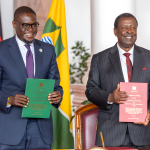
President Ruto and Governor Sakaja signed a cooperation agreement allocating funds for 50,000 new streetlights, water plants saving 50 million litres daily, 27 km Nairobi River sewer and ward road upgrades, with Ruto calling it a partnership to make the city livable while opposition senators warn of devolution threats.
A staff member at Moi Teaching and Referral Hospital allegedly stole Sh10 million by falsifying patient bills as paid in the eCitizen system while diverting the money to her personal account, prompting an ongoing police and hospital investigation.